From the golden sand of Fetovaia and Cavoli in the south to the white pebbles of Sansone and Capo Bianco in the north, the guide to Elba's beaches with up-to-date sea conditions, so you can choose where to go today.
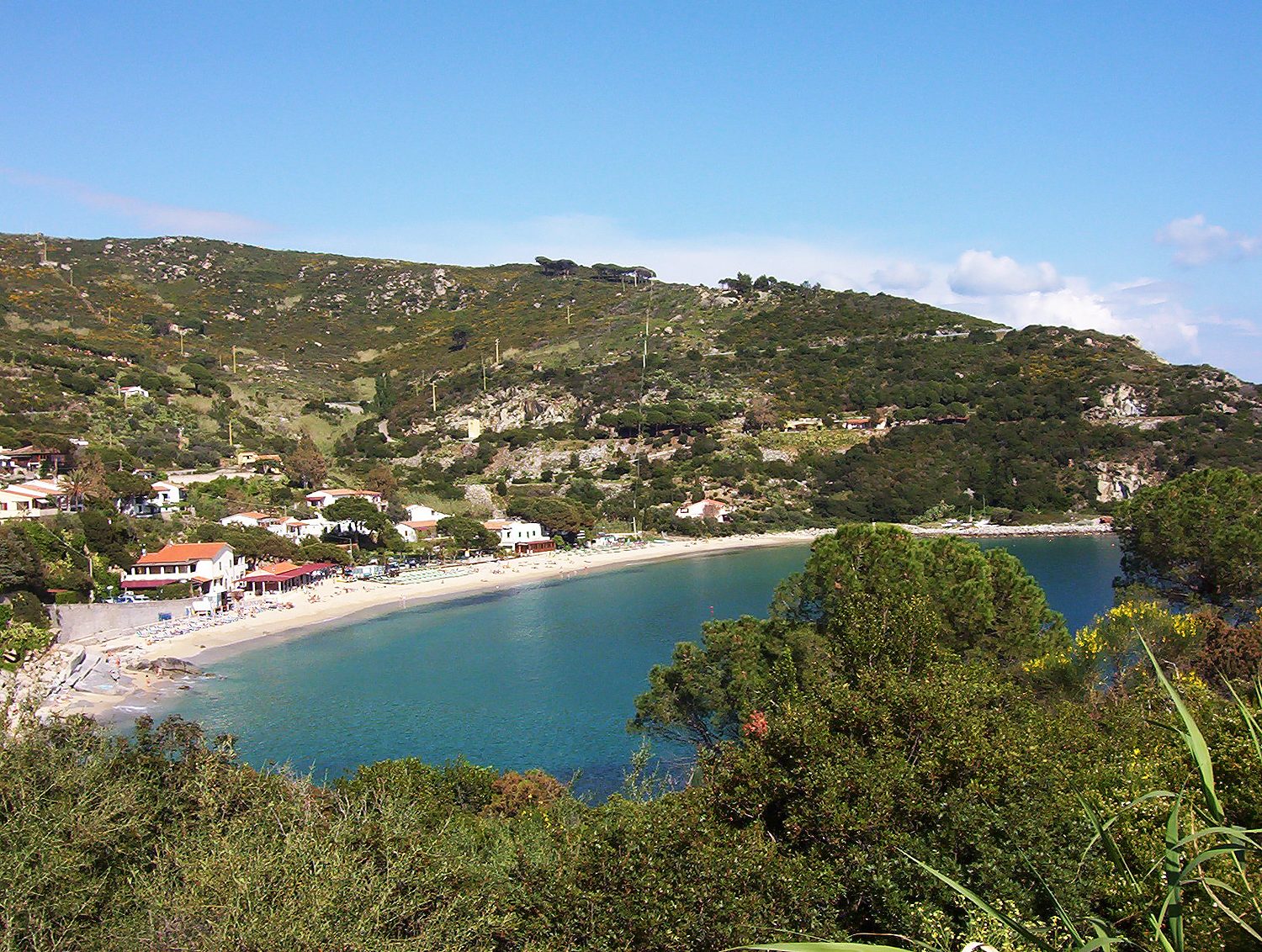
Elba, the largest island in the Tuscan Archipelago, has a jagged coast that changes face from one bay to the next: golden, granite-born sand in the south, white pebbles and pale cliffs in the north, little coves of dark, iron-rich sand in the area of the old mines. The whole island is part of the Tuscan Archipelago National Park.
Its elongated shape is also the secret to always finding the right side: when one side catches the wind, the sea usually stays calm on the other side of the island. Below are the most beautiful public beaches, each with today's sea conditions: tap a row to open the full card with waves, wind and water temperature.
The south coast: Fetovaia, Cavoli and Marina di Campo
Elba's southern side has the most golden sand and the warmest water on the island, sheltered as it is from the northerly winds that blow most often.
Fetovaiacalm sea · water 23 °C
A bay of fine, golden, granite-born sand, closed off by a headland. It is sheltered from almost every wind: Punta Fetovaia protects it from the west and Monte Capanne from the north, and it holds up well even in a mistral. The scirocco from the southeast is the only wind that really disturbs it.
Cavolicalm sea · water 23 °C
Coarse, golden granite sand, a shallow seabed and a southern exposure, in a warm microclimate. It is sheltered from northerly winds: in a mistral it becomes a swimming pool. One of the busiest and liveliest beaches on the island.
Marina di Campocalm sea · water 23 °C
A wide arc of pale sand in the bay of the same name, on the southern side, with a gently sloping seabed. Its position sheltered from northerly winds makes it one of the handiest choices on the island in a mistral.
The north coast: Sansone, Capo Bianco and Padulella
Around Portoferraio lies the most scenic stretch of Elba: white cliffs and pebbles and water in intense colours, from emerald green to turquoise.
Sansonecalm sea · water 23 °C
White gravel and pebbles beneath pale cliffs, with very clear water. It is reached by a downhill path of ten to fifteen minutes. It faces north and is at its best in a scirocco and with southerly winds, when the sea on the northern side settles.
Capo Biancocalm sea · water 23 °C
White pebbles and grainy sand at the foot of pale cliffs, near Portoferraio. It has a large car park and you go down a few steps. Facing north, it is calm with southerly winds.
Padulellacalm sea · water 23 °C
Small, smooth white pebbles beneath pale cliffs, with emerald-coloured water. It is sheltered from the west by Capo Bianco, faces north and is at its best with southerly winds.
Sant'Andreasea with a few waves · water 24 °C
A small beach of pale granite sand, enclosed by granite rocks, in the northwestern corner of the island. Tucked away and bright, it is a good choice with southerly winds.
The southeast coast: Lacona, Innamorata and Barabarca
Between Capoliveri and the gulf of Lacona, long sandy beaches with dunes alternate with sheltered coves of dark sand, a legacy of the island's mining past.
Laconacalm sea · water 24 °C
A long sandy beach with a protected dune system and a very shallow seabed, handy with children. It is open only to southerly winds, while it stays sheltered in a tramontana, grecale and mistral.
Innamoratacalm sea · water 24 °C
Dark, iron-rich sand and gravel, facing the Gemini islets. It is doubly sheltered, from the north by Punta Pareti and from the south by Punta della Ciarpa, while it is more exposed to easterly and northeasterly winds.
Barabarcacalm sea · water 24 °C
Pale sand and small pebbles in a bay closed off by two points, which make it well sheltered. You go down a steep stairway, and for that very reason it stays quieter.
When the sea is calm on Elba
The rule for Elba is simple and holds almost always: switch sides depending on the wind. With northerly winds such as the mistral, tramontana and grecale, the sea is calm on the south coast, at Cavoli, Fetovaia, Lacona and Marina di Campo. With southerly winds such as the scirocco and libeccio, the sea settles on the north coast, at Capo Bianco, Padulella, Sansone and Sant'Andrea. With beaches exposed in every direction, there is almost always a sheltered side on the island. MareCalmo takes into account each beach's exposure to wind and waves, so you can see at a glance where the sea is calmest today.
Practical tips
- Switch sides with the wind. Wind from the north, go south; wind from the south, go north: it is the rule that saves the day on Elba.
- Go early. In the morning the sea is usually calmer, before the breeze picks up, and parking is easier to find.
- Water shoes help. Many beaches are pebble or gravel and are reached along steep paths: comfortable footwear is best.
- Respect the Park. The whole island is in the Tuscan Archipelago National Park: stay on the paths, do not damage the dunes and leave no litter.
Frequently asked questions
Which is the most beautiful beach on Elba?
Fetovaia and Cavoli in the south, Sansone and Capo Bianco in the north are among the most loved, but there is no single most beautiful beach: there is the most beautiful one today. With the right wind a bay is perfect; with the wind against it, it turns choppy and gusty. That is why it is worth checking the sea conditions before you set off.
Where to go to the beach on Elba when it is windy?
It depends where it blows from. With northerly winds the south coast is best, such as Cavoli and Fetovaia; with southerly winds the north coast is best, such as Capo Bianco and Sansone. As the island has beaches exposed in every direction, there is almost always a sheltered side where the sea is calm.
When is the sea calmest?
Usually early in the morning and, depending on the wind, on the sheltered side of the moment: the south coast with northerly winds, the north coast with southerly ones. The calm sea today page shows you in real time where to find it now.
Some links are affiliate links: booking helps support MareCalmo, at no extra cost to you.